CARE PLANS & RISK

Care planning software for UK care homes

Digital care planning for UK care homes: person-centred care plans, risk assessments, reviews and daily records in one living resident record — written where the care happens, and dated and attributed so the history stands up to scrutiny.

The whole system
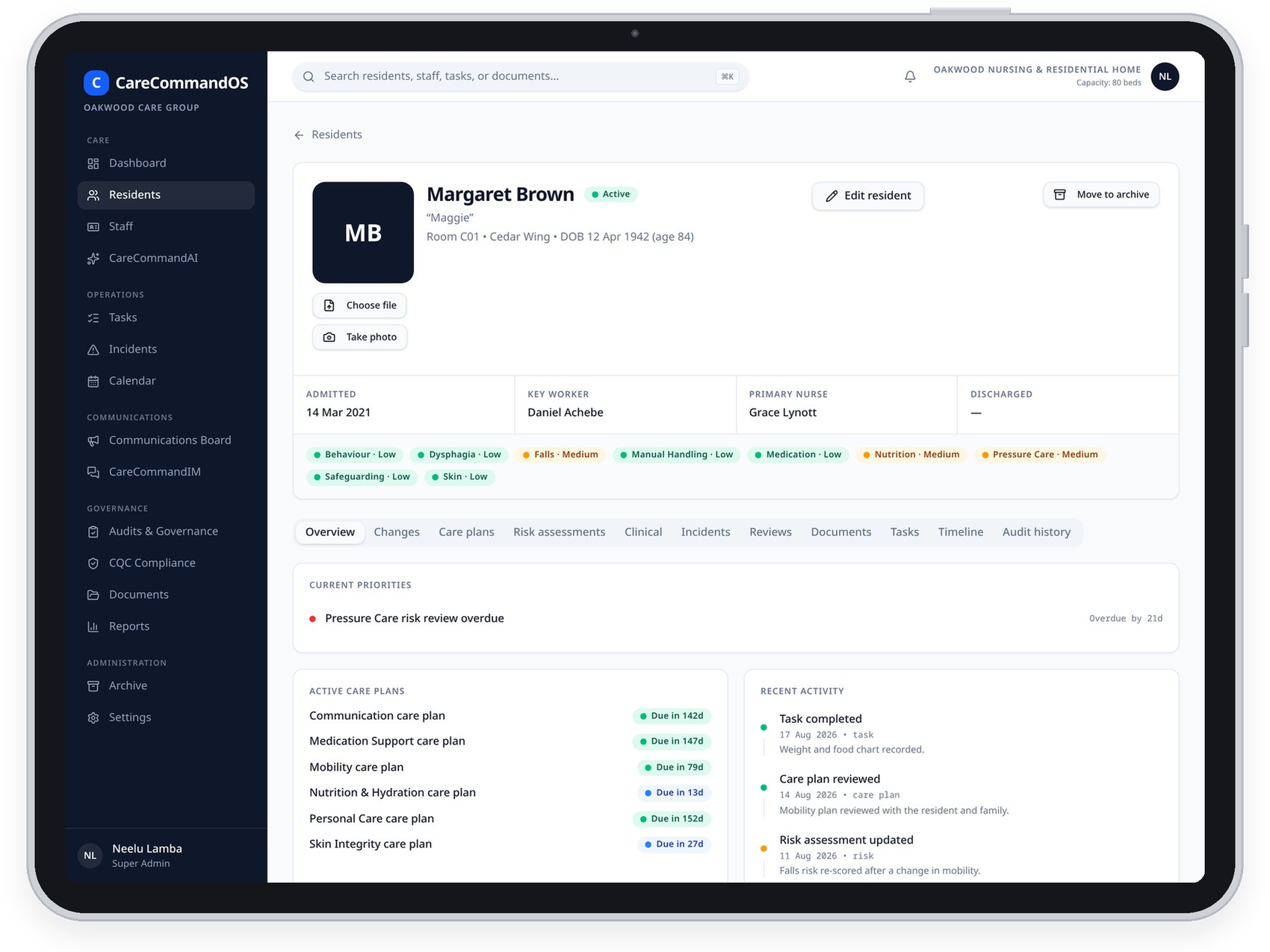
Resident record and care plan in CareCommandOS (example data)

Screens shown with example data only.

A care plan is only useful if the people giving care can see it

Plans are often written well and then read rarely. They sit in a system the office uses, while the floor works from a handover sheet, a whiteboard and memory. Risk assessments are reviewed on a different schedule from the plan they belong to, and a change made after an incident may never reach the carer on the next shift.

The consequence is quiet and familiar: care delivered from an out-of-date picture, and a record that cannot show why a decision was made.

CareCommandOS keeps the plan, the risks, the daily notes and the reviews in the same record, on whatever device the person is holding, with a dated history behind every change.

WHAT’S INSIDE

From admission to review, in one record

01

One resident record, not a folder of documents

Everything about a resident sits in one place: their care plan sections, risk assessments, health information, preferences and life history, daily notes, incidents, reviews and documents. Staff coming on shift read the current picture rather than piecing it together from several systems and a handover sheet.
02

Care plan sections you define

Plans are built from the categories and sections your service uses — mobility, nutrition, continence, skin integrity, communication, mental capacity, end of life — and can start from a template so a new admission is written up consistently. Wording stays yours; the structure just stops sections being forgotten.

03

Risk assessments that stay attached

Falls, moving and handling, nutrition, skin, choking and behaviour assessments live alongside the plan they inform, with review dates that surface before they lapse. A change in risk is visible next to the care that responds to it, not filed separately.

04

Reviews that prompt themselves

Monthly reviews and reassessments appear as due work, with the last version to compare against. Overdue reviews are visible to managers before an audit finds them, and a completed review records who did it and when.

05

A full history behind every change

Care plans are never quietly overwritten. Each edit is dated and attributed, so you can show how the plan changed after an incident, a hospital discharge or a family conversation — which is exactly what an inspector, a coroner or a relative asks about.

06

Written on the floor, not at the end of the shift

The record works on a phone or tablet at the point of care, so notes are written while they are accurate. Nothing depends on somebody typing up the day from memory after handover.

The same record answers the manager’s questions

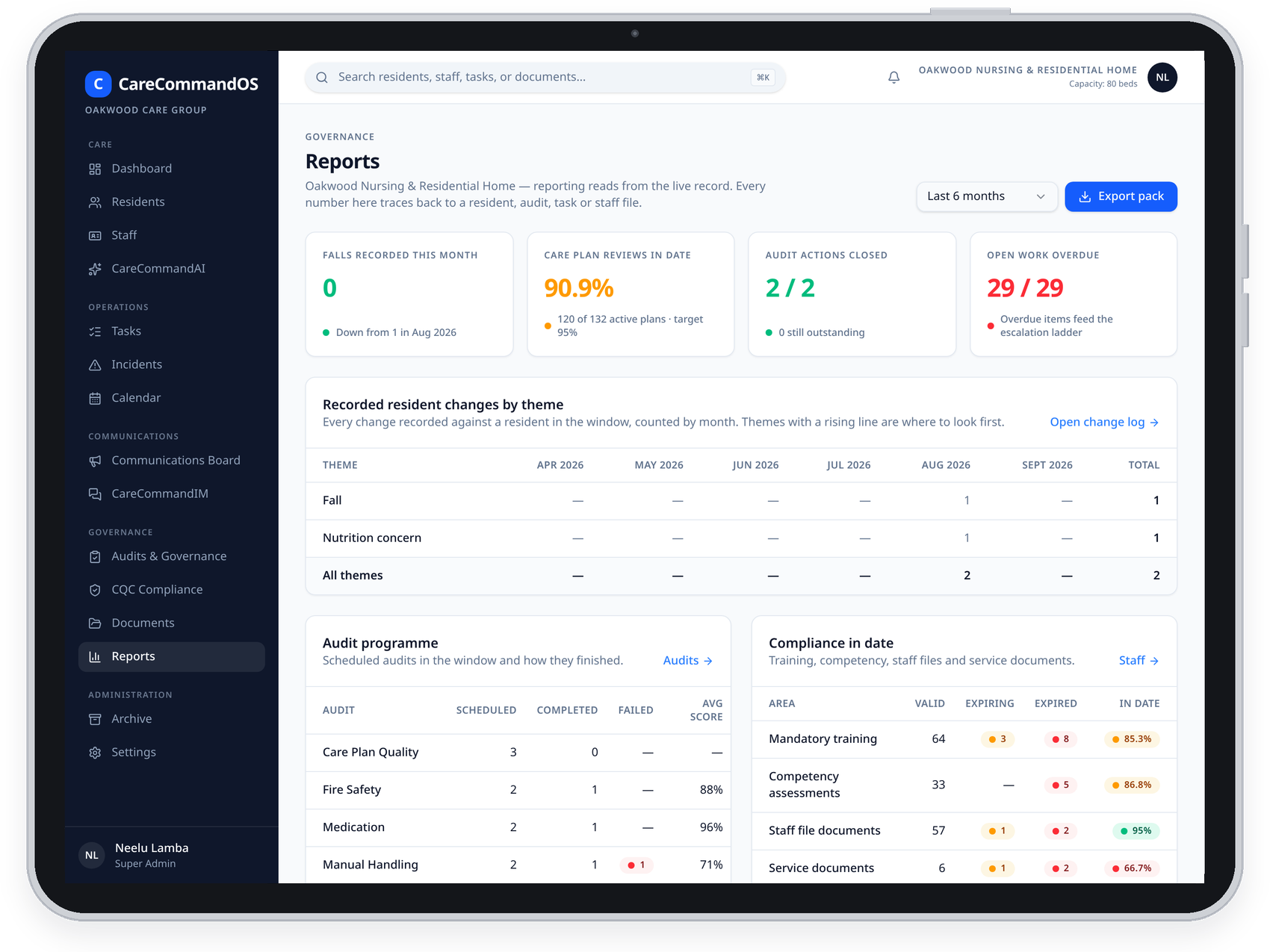
Because care plans, reviews, incidents and risk assessments are one dataset, reports are read from live records rather than assembled by hand: overdue reviews, plans not updated after an incident, residents whose risk has changed, weight and falls trends across the home.

For an operator running several homes, the same view compares services without asking each manager for a spreadsheet.

Reports drawn from live resident records in CareCommandOS (example data)

See a resident record with example data

A short demo walks through a care plan, its risk assessments and a review. Accounts are invite-only, so nothing is set up until you decide to go ahead.

Back to homepage